

El Comité de ética de la investigación con medicamentos de Euskadi (CEIm-E)es un órgano independiente, de composición multidisciplinar, cuya finalidad principal es velar por la protección de los derechos, seguridad y bienestar de las personas que participen en un proyecto de investigación biomédica, garantizando la correcta aplicación de los principios
20/05/22
Molecular characterization of a non-coding mutation in GRN gene and investigation of CRISPR-dCas13 system for splicing modulation
.
11/05/22
Pint of Science Donostia: 9, 10 y 11 de Mayo
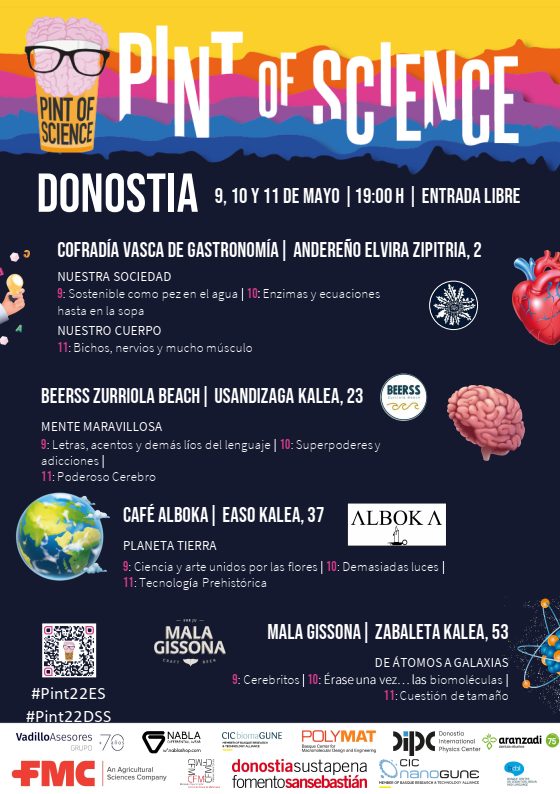
Bichos, nervios y mucho músculo. 11 mayo 19:00-20:30. Sociedad Gastronómica – Donostia
Algunas formas de estudiar los sistemas biológicos pueden sorprendernos. ¿Cómo pueden los insectos ayudarnos a entender problemas médicos? ¿Qué pasa en nuestro cuerpo cuando envejecemos? Un pequeño vistazo a nuestro cuerpo y la investigación médica.
Investigadores del IIS Biodonostia participan en la jornada del 11 de mayo con el siguiente programa:
19.00-19.45
Francisco Javier Gil Bea y Gorka Gereñu Lopetegi, (IIS Biodonostia)
Piel, insectos y otros trampantojos en neurociencia
El manual del funcionamiento del cerebro humano es objeto de codicia. El problema es que sus células están aisladas en una caverna oscura e inaccesible, y solo tras un desenlace fatal podemos interrogarlas: en ese punto quedan los restos de un naufragio que difícilmente ayudan a comprender los procesos neuronales. Hoy en día podemos convertir una célula de la piel de un individuo en una neurona suya o humanizar cerebros de insectos como la mosca de la fruta. Aquí hablaremos de éstas y otras supercherías que usan los neurocientíficos para torturar las neuronas hasta que revelen sus secretos.
19.45-20.30
Sandra Fuertes Álvarez (IIS Biodonostia)
(Des)Conectando nervios y músculos: envejecimiento a pequeña escala
La unión entre los nervios y los músculos es esencial para que podamos movernos y realizar las tareas diarias. Pero ¿Cómo funcionan? ¿Qué pasa cuando envejecemos? Unas pinceladas sobre lo que ocurre a nivel microscópico en nuestro cuerpo.
05/05/22
Workshop on Centenarians: Models of healthy aging
Centenarians are a segment of the population that exhibits extreme longevity and is rising exponentially, with expectations of becoming the age group with the highest growth rate in the coming decades. Their longevity seems to be accompanied by a lower number of comorbidities and a better quality of life; that´s why some studies propose them as models of healthy aging.
The International Meeting “Centenarians: Models of healthy aging” that will be held on San Sebastian (Spain) will discuss the characteristics of this population group focusing on multidimensional research in centenarians including demographic, epidemiological, clinical, functional, psychosocial and biological aspects.
Organizing Committee
Ander Matheu. Oncology Area, Biodonostia Health Research Institute, San Sebastian, Spain; CIBER of frailty and healthy aging (CIBERfes), Madrid, Spain
Itziar Vergara. Primary Care Area, Biodonostia Health Research Institute and Donostia University Hospital, San Sebastian, Spain
Estefanía Carrasco-García. Oncology Area, Biodonostia Health Research Institute, San Sebastian, Spain
José Viña. Physiology Department, Valencia University, Valencia, Spain; CIBER of frailty and healthy aging (CIBERfes), Madrid, Spain
Scientific Committee
Ander Matheu. Oncology Area, Biodonostia Health Research Institute, San Sebastian, Spain
José Viña. Physiology Department, Valencia University, Valencia, Spain
Program
Day 1. Thursday, 5th May 2022
________________________________________________
16.00-16.30 Welcome opening
16.30-18.30 Plenary session I: Demographic, social and psychosocial characteristics of centenarians
16.30-17.00 María Trinidad Herrero. Institute for Aging Research, Murcia. Sex, rurality and socioeconomical status in Spanish centennial population
17.00-17.30 Angel Belenguer. Alzira University Hospital (Valencia), Spain. Factores asociados a la supervivencia en edades extremas”. Resultados del análisis de supervivencia de los grupos de Centenarios estudiados en el área de La Ribera de Valencia
17.30-18.00 Antonio Ayala. University of Sevilla, Spain. Rutas de la longevidad y síntesis de proteínas
18.00-18.15 Itziar Vergara. Biodonostia Health Research Institute, Spain. Estudio poblacional en un pueblo de la región de Guipúzcoa
18.15-18.45 Francisco José Garcia-García. Complejo Hopitalario Toledo, Spain. Características y fenotipos en la cohorte Toledo.
18.45-20.00 Plenary session II: Grupo Español de Investigación Centenarios –
18.45-19.15 José Viña. Valencia University, Spain. Grupo Español de Investigación Centenarios – Actualización.
19.15-20.00 Jornada Administrativa Grupo Español de Investigación en Centenarios Debate – Time for Project discussion
21.00 Dinner
Day 2. Friday, 6th May 2022
________________________________________________
9.00-10.00 Keynote Talk: Claudio Franceschi. University of Bologna, Italy. Centenarians and Inflammaging: chronological versus biological age
10.00-11.00 Plenary session III: Functional activity of centenarians
10.00-10.30 Nuria Garatachea. Zaragoza University, Spain. Entrenando centenarios.
10.30-11.00 José Viña. Valencia University, Spain. Centenarians and their offspring delay the onset of frailty: transcriptomic analysis
11.00-13:45.00 Plenary session III: Genetic and biological characteristics of centenarians I
11.00-11.30 Consuelo Borras. University of Valencia, Spain. Critical function of the control of apoptosis in healthy, extraordinary aging – role of Bcl-xL
11.30-11.45 Coffee Break
11.45-12.15 Ander Matheu. Biodonostia Health Research Institute, Spain. Analysis of centenarians brain transcriptomic
12.15-12.30 Ander Saenz. Biodonostia Health Research Institute, Spain. Correlation between chronological age and pattern of expression in the brain
12.30-12.45 Mario Muñoz. University of Sevilla, Spain. Microbiota y envejecimiento cerebral
12.45-13.15 Reinald Pamplona. Lleida Health Research Institute, Spain. Metabolismo de metionina y longevidad
13.15-13.30 Mariona Jove. Lleida Health Research Institute, Spain. Adaptaciones del lipidoma en centenarios
13.30-13.45 Joaquim Sol. Lleida Health Research Institute, Spain. Características metabolómicas en humanos longevos
13.45-14.15 Plenary session IV: Future Perspectives
13.45-14.15 Francisco José Tarazona. Alzira University Hospital (Valencia), Spain “. ¿Hacia dónde dirigir la investigación en cohortes de centenarios y descendientes?
14.30-16.00 Lunch y Jornada Administrativa Grupo Español de Investigación en Centenarios Debate – Time for Project discussion
29/04/22
Impact of acute influenza infection in lung tumor progression and the tumor microenvironment
.
05/04/22
Role of Chaperone-Mediated Autophagy and Histone Deacetylases in Glioblastoma and Brain Aging – A focus on Stem Cell Maintenance
.
01/04/22
Comparison of different copy number variations (CNVs) detection tools using whole genome sequencing (WGS) data
.
25/03/22
Drosophila melanogaster como modelo para caracterizar un nuevo caso de mutación en ATAD3
.
11/03/22
Identification of a gene expression pattern associated with frailty and related to senescence
.
25/02/22
Characterization of D. melanogaster models for LRRK2-linked Parkinson’s disease study
.
11/02/22
El papel del entorno urbano en la salud mental durante el embarazo. Resultados del estudio UGARE .
.
28/01/22
Effects of kv1.3 inhibition in type 2 diabetes-induced cardiac electrical remodeling
.
28/01/22
Cholangiocarcinoma biomarkers in biofluid extracelular vesicles: a new liquid biopsy strategy
.