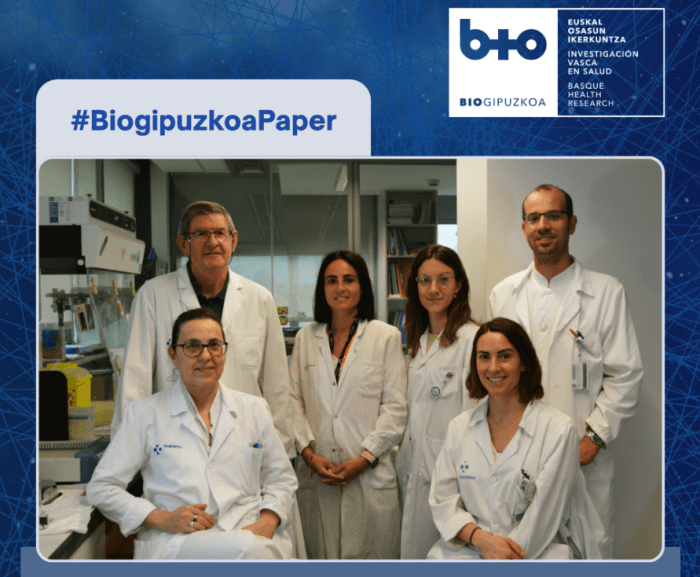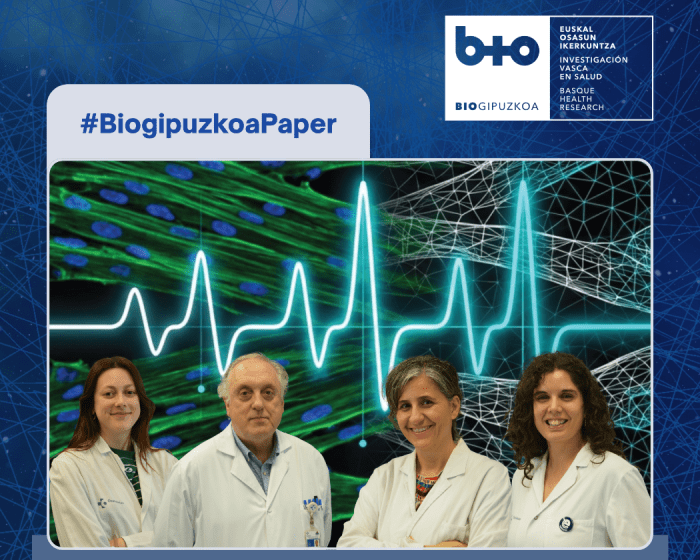

In the latest Spanish Gastroenterology Association congress held in Madrid in March, 2 works received awards involving the Gastrointestinal Diseases research group, led by Dr Luis Bujanda Fernández de Piérola at the Biodonostia Institute.
One of them obtained the prize for the best clinical oral presentation entitled “Immunological occult blood test diagnostic security in patients with gastrointestinal symptoms” and the other award was for the best basic oral presentation entitled “GSK3 inhibitors combined with TRAIL as a strategy to induce apoptosis in pancreatic cancer.”
Both works have been accepted by two international scientific journals: Colorectal Disease and Cell Death Disease.
The first work studied 787 patients who came to the digestive clinic with digestive discomfort where there was a chance that these symptoms might be due to colonic cancer. The study demonstrates that the immunological occult blood test (IOBT) is more sensitive and specific to detect colonic cancer than the clinical criteria applied by the National Institute for Clinical Excellence (NICE) in the United Kingdom or the SIGN guide.
Clinical and analytical data (hemogram, carcinoembrionic antigen, fecal calprotectin and IOBT) was collected from all of them and each underwent a colonoscopy. Colonic cancer was detected in 97 (12.3%) patients. The IOBT test over 100 ng/ml had a sensitivity and specificity of 87.6% and 77.4%, respectively, to detect colonic-rectal cancer.
The sensitivity and specificity of the NICE criteria was 61.9% and 65.2%, respectively. The sensitivity and specificity of the SIGN criteria was 82.5% and 42.7%, respectively. The study suggests that the IOBT test has greater diagnostic security for detecting colonic-rectal cancer than the NICE and SIGN criteria in patients that come to specialised clinics with suspected colonic cancer.
The aim of the second work was to find out if using GSK3 inhibitors could induce cell sensitivity in the apoptosis produced by TRAIL, and this combination turned out to be an effective tool to treat pancreatic cancer.
They studied the effect produced by combining TRAIL treatment with a GSK3 kinasa activity inhibitor (LY2064827, Laboratory, Eli Lilly) in different in vitro cell lines of pancreatic adenocarcinoma.
The results demonstrate that while the treatment only with TRAIL or with LY2064827 does not produce significant effects in the cells, the combined and sequential treatment of LY2064827+TRAIL leads to cell growth inhibition, an increase in the split of the Caspasa 3 protein and PARP in pancreatic tumour cells and finally an increase in the apoptosis. At a molecular level, we can see that the GSK3 inhibition prevents phosphorylation of GSK3 ?/? in several tyrosine and serine residues and increases the accumulation of ?-catenin in the nucleus of tumour cells. Consequently, a reduction can be seen in the levels of the Bcl-xL and cIAP2, anti-apoptotic proteins, allowing TRAIL to unchain effective apoptosis.
In conclusion, the study has demonstrated that combining GSK3 inhibitors with TRAIL constitutes an effective therapy for treating pancreatic cancer.
Cubiella J, Salve M, Díaz-Ondina M, Vega P, Alves MT, Iglesias F, Sánchez E,Macía P, Blanco I, Bujanda L, Fernández-Seara J. Diagnostic accuracy of faecal immunochemical test for colorectal cancer in symptomatic patients: comparison with NICE and SIGN referral criteria. Colorectal Dis. 2014 Jan 24. doi: 10.1111/codi.12569. [Epub ahead of print] PubMed PMID: 24456168.
Zhang JS, Herreros-Vilanueva M, Koenig A, Deng Z, de Narvajas AA, Gomez TS,Meng X, Bujanda L, Ellenrieder V, Li XK, Kaufmann SH, Billadeau DD. Differential activity of GSK-3 isoforms regulates NF-?B and TRAIL- or TNF? induced apoptosis in pancreatic cancer cells. Cell Death Dis. 2014 Mar 27;5:e1142. doi: 10.1038/cddis.2014.102. PubMed PMID: 24675460.